

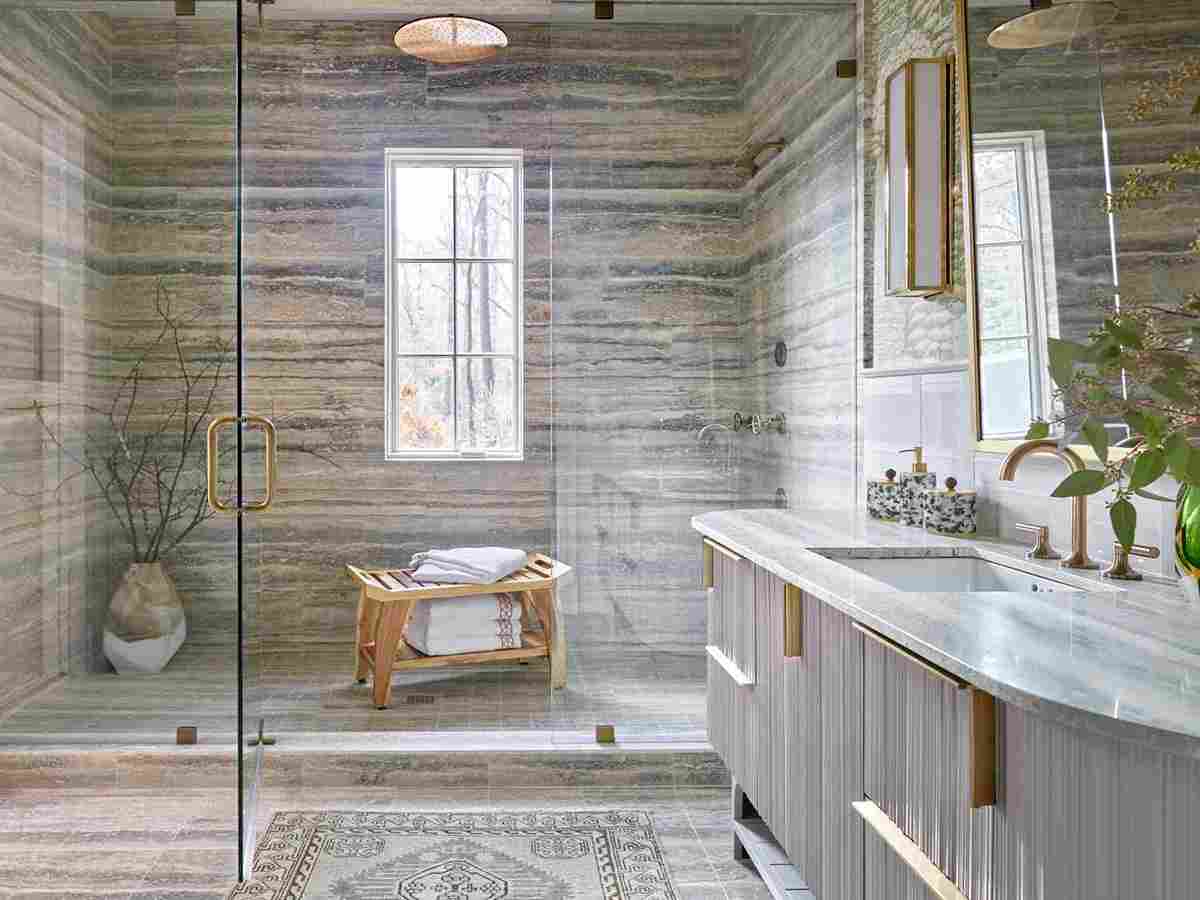
Choosing the right 36-inch bathroom vanity can transform a small bath from cramped to comfortable.
The ten ideas below explore how this versatile size can optimize style, storage, and circulation in tight quarters.
Versatile vanity styles: find your 36-inch statement piece
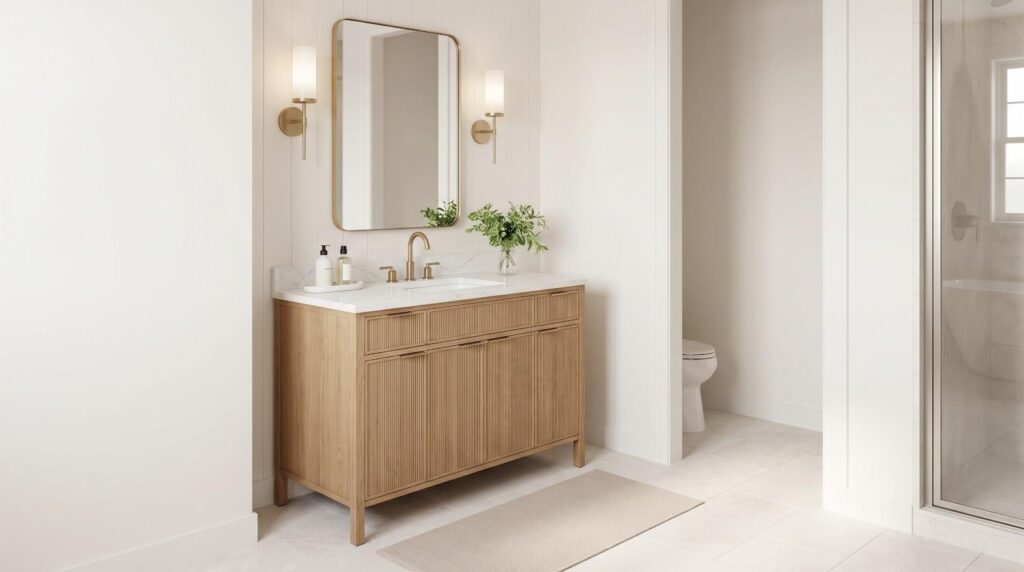
A 36-inch cabinet is a blank canvas. Modern, farmhouse, vintage, coastal—nearly every design genre fits this width, so your first step is deciding which vibe you want anchoring the room.
Start by weighing visual presence. A wall-hung, gloss-white box recedes, letting tile or wallpaper shine.
A furniture-style oak console with tapered legs does the opposite: it becomes the focus and adds warmth. Both share the same 36 × 21-inch footprint, yet they tell completely different stories.
Sightlines matter. In tight baths, pieces with open shelves or slender legs expose more floor tile, tricking the eye into reading the room as larger.
Fully skirted cabinets stash the most clutter but can read as a solid block in a 5 × 8-foot space. Decide whether visual lightness or maximum hidden storage matters more to you.
Color is the next lever. In the 2025 Houzz Bathroom Trends Study, wood tones edged out white as the top vanity finish—28 percent versus 20 percent—confirming the shift toward natural, tactile surfaces.
That rise makes a bold paint color such as emerald, navy, or matte black stand out even more against oak and walnut.
Need real-world references? Atlanta-based Willow Bath and Vanity’s floating Hampton 36-inch in warm teak pairs clean lines with spa-ready grain.
The company offers more than 170 other 36-inch options in sustainable teak, mango, and white oak, plus floating, freestanding, and offset-sink layouts—shop the collection to compare materials and configurations.
According to the company’s specs, the Hampton unit is crafted from moisture-resistant, FSC-certified teak and ships pre-assembled with soft-close drawers plus a choice of nine quartz or marble tops.
Prefer a dressier feel? The Caroline Avenue 36-inch in crisp white delivers soft-close drawers and timeless shaker detail.
Tape out 36 × 21 inches on your floor, step back, and picture each persona—sleek minimalist, rustic farmhouse, tailored traditional—filling that rectangle.
Once one vision clicks, every other decision falls neatly into place.
Floating vanities: free up floor space
When square footage is tight, every slice of visible floor feels like a win. The moment a 36-inch vanity lifts off the tile, the room reads wider.
Here’s why it works. With the cabinet off the ground, the eye tracks one uninterrupted plane from wall to wall.
Even a 12-inch (30 cm) gap between vanity and floor widens sightlines and removes the boxed-in look created by baseboards.
Cleaning also gets easier; you can sweep or mop in one pass because there’s no toe-kick catching dust.
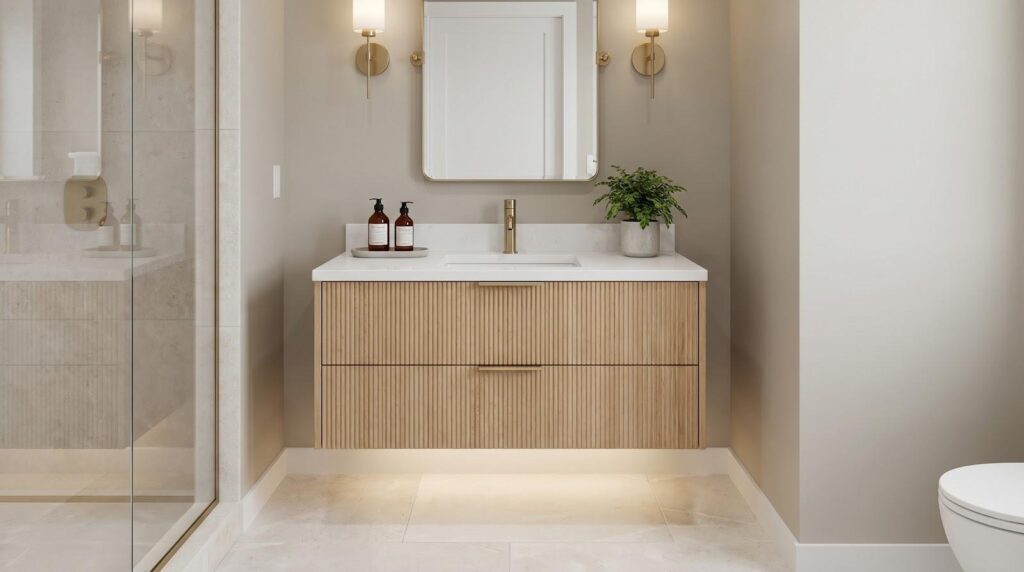
You don’t lose storage. Most floating models include full-depth, soft-close drawers that still hold hair tools and spare towels.
The drawers simply start higher, leaving legroom for an optional LED strip that adds a gentle under-glow.
Planning the install? Anchor a cleat or heavy-duty brackets into the studs, then set the counter about 34 in (86 cm) above the finished floor. That hits comfort height while keeping mirrors at eye level.
Need a reference point? The Hampton 36-inch Floating Vanity in warm teak glides silently above a bar of light, making a 5 × 8-foot bath feel open instead of cramped.
Slim-profile vanities: trim depth, gain breathing room
Sometimes width is fine; the challenge is how far the cabinet projects into the walkway. Standard vanities sit about 21 in (53 cm) from the wall.
Drop that to 18 in (46 cm) and you pick up a 3 in (8 cm) buffer that makes sidestepping a partner or an open shower door feel easy.
Designers often specify 18 in deep units for condo baths where every centimetre counts.
Think of it as a lean version of storage. You keep the full 36 in counter for soap, skincare, and a candle, yet the slimmer body hugs the wall and widens the path between vanity edge and the opposite fixture.
That modest shift helps a 5 ft × 8 ft (1.5 m × 2.4 m) room meet code clearance without forcing you down to a 30 in sink.
A shallow profile does tweak the sink geometry. Many models pair an integral basin that measures only 12–13 in (30–33 cm) front to back.
The bowl feels cozier, so choose a compact faucet with a forward-angled spout to manage splashes.
One example is Lark Manor’s Ardilia 36-inch on Wayfair.
It is 18 in deep, puts drawers on top and doors below, and ships with matte-black hardware that suits a modern cottage look. Big-box lines also carry flat-panel options at the same slim depth for less than $800.
Installation tip: confirm that your drain stub-out lands inside the new cabinet footprint.
Most shallow units leave about 4 in (10 cm) behind the drawer bank, so a centred rough-in prevents pipe rerouting.
Trim those 3 in, and you will notice the extra breathing room every time you walk by.
Offset-sink layouts: stretch your counter, not your walls
Centering the basin is tradition, not a rule. Slide the bowl left or right and the same 36 in (91 cm) vanity hands you a continuous 20 in (51 cm) landing zone.
That extra surface feels spacious in a small bath where toothbrushes, skincare, and a flat iron usually fight for elbow room.
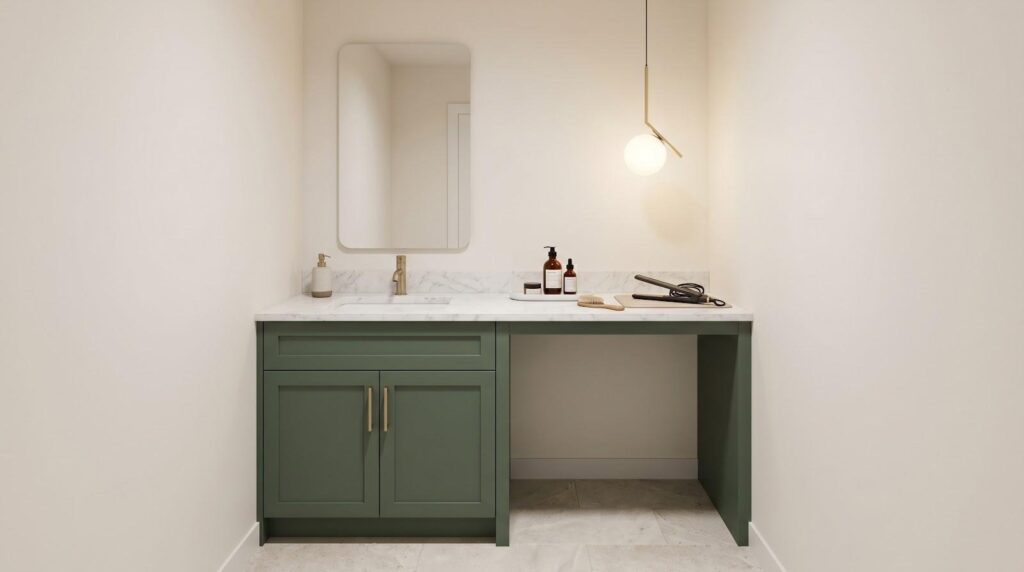
A single wide platform beats two narrow slivers divided by a faucet.
You can spread out makeup without pieces toppling into the drain, or park bath toys while still reaching the sink. Morning traffic flows with less clutter.
The asymmetric silhouette also invites creative lighting.
Hang a pendant over the open counter, place the mirror above the basin, and you achieve a gallery-level vignette without moving a wall.
Plumbing changes are modest. Supply lines flex, and shifting the drain about 12 in (30 cm) is often solved with a longer trap arm or a 45-degree elbow.
Need a visual? The Ariel Hepburn 36-inch in vintage green tucks the sink to the left, freeing a Carrara slab on the right. Add brass pulls and you get storage, prep space, and a style statement in one compact footprint.
Shift the sink, gain a prep deck; that simple move turns a tight bath into an efficient workspace.
Drawer dividers and smart storage upgrades
A vanity’s best potential sits behind its fronts.
Swap a hollow cabinet for deep, organized drawers and you claim every cubic inch (or cubic centimetre) that fixed shelves waste.
Designers call this “vertical efficiency”, stacking items in layers you can see instead of losing them in the back.
Begin with simple bamboo or acrylic dividers. Slot them like bookends, and hair tools, skincare bottles, and toothpaste each stay in a tidy lane.
Next, add pull-out organizers. Rev-A-Shelf’s narrow metal caddy slides from behind a door and parks the hair dryer, curling wand, and cords in heat-safe holsters. Close the door and the counter stays clear.
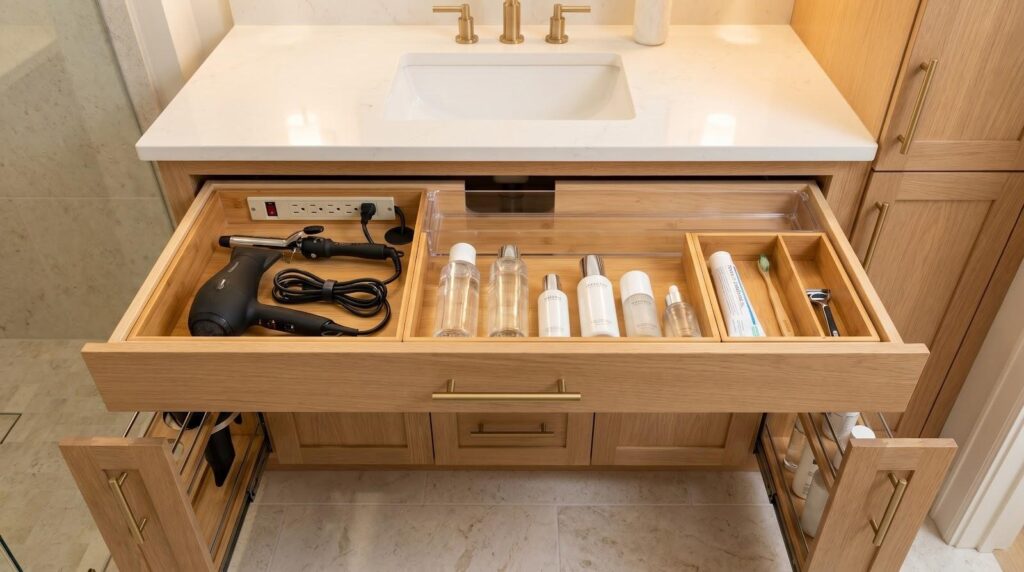
Power is the final upgrade. Many premium 36 in (91 cm) vanities hide a GFCI outlet strip inside the top drawer; plug in electric toothbrushes or shavers, charge overnight, then shut the drawer so cords stay tamed.
Retrofit kits put these perks within reach even for an existing cabinet.
A licensed electrician can run power through the back panel in under an hour, and most organizers fasten into factory holes.
Sort the inside and you will feel the calm outside. In a compact bath, that serenity matters more than in any other room.
Open-shelf vanities: show off storage, lighten the look
Closed doors hide clutter but add visual weight. Trade the base cabinet for a 36 in (91 cm) console with an open bottom shelf and the room immediately feels lighter.
You will see more floor tile, light will bounce underneath, and the vanity reads as furniture instead of a solid block.
Styling is simple. Stack two baskets, one for spare rolls and one for hand towels, then leave breathing room so the shelf does not look crammed. That balance of function and open space is what gives spa baths their calm vibe.
Open shelving suits farmhouse and coastal schemes where woven textures, folded linens, and a small trailing plant become part of the decor.
The Everett 36-inch at Home Depot hits the mark with an open shelf and soft blue paint that pairs with matte-black faucets.
Concerned about dust? Use lidded baskets or washable fabric bins and wipe the shelf during weekly cleaning. If moisture is an issue, choose teak or sealed oak; both resist humidity better than particleboard.
You still get drawers up top for the untidy items, so nothing essential is lost. Instead, you gain visual lightness that makes a 5 ft × 8 ft (1.5 m × 2.4 m) bath feel about 1 in (2.5 cm) wider on each side, a difference you will notice every morning.
Bold color pop: make the vanity the star
White cabinets feel safe, but they seldom make a statement.
Paint a 36 in (91 cm) vanity deep emerald, inky navy, or charcoal black and the entire room gains energy. Because the vanity is the largest object in most small baths, one confident hue delivers maximum impact on minimal square footage.
Deep color does more than catch the eye.
Dark tones soften edges, helping the cabinet recede rather than crowd the room. Pair midnight navy with brushed-gold pulls and a guest bath reads upscale.
Prefer green? Paint brands from Sherwin-Williams to Benjamin Moore highlighted rich forest shades in their 2025 trend reports, underscoring their popularity.
You do not need a new cabinet to join the trend.
A weekend with high-adhesion primer, enamel paint, and fresh hardware turns a tired builder-grade box into a focal point.
Shopping instead of painting? The Ariel Hepburn 36-inch in vintage green arrives pre-finished with a Carrara top.
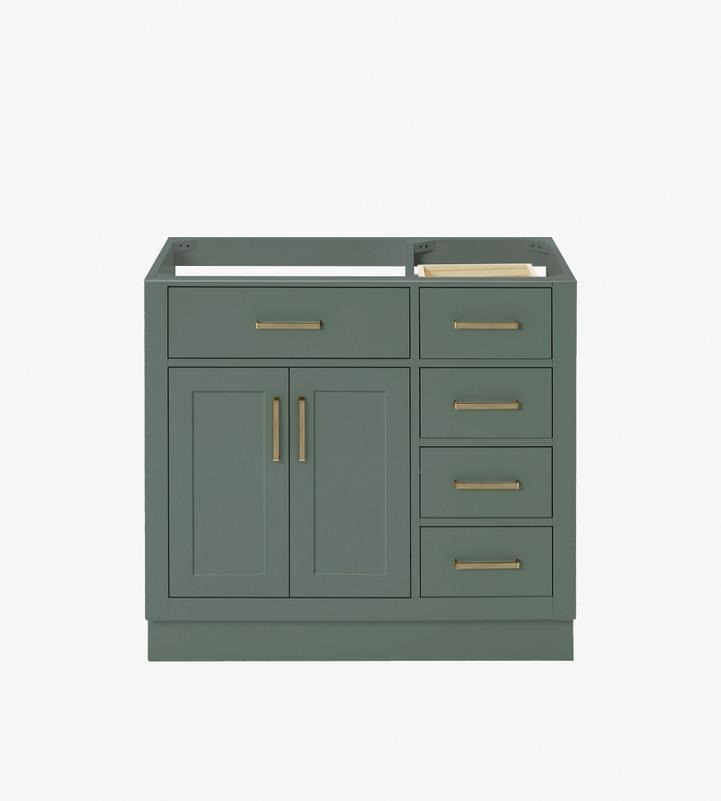
Ariel Hepburn 36 inch vintage green bathroom vanity product photo
Lighting seals the effect. Dark fronts need balanced brightness, so flank the mirror with sconces or install a back-lit glass to keep the color crisp, not cavernous. One bold brushstroke plus thoughtful light helps a compact bath feel curated, not cramped.
8 Modern-farmhouse warmth: rustic wood meets matte black
Want that blend of rustic character and clean lines filling design feeds? A 36 in (91 cm) vanity in natural or distressed wood brings farmhouse charm without overwhelming a compact bath. Visible grain adds texture, while matte-black hardware and faucets keep the look current, not kitsch.
Contrast does the work. Warm oak or reclaimed teak softens hard tile surfaces, helping a small room feel friendlier. Black pulls, hinges, and a slim gooseneck faucet outline the cabinet, defining edges so the palette never turns muddy. Add a black-rimmed round mirror and the elements read as one cohesive set.
Durability supports style. Solid-wood vanities such as Willow’s Oak 36 line arrive pre-sealed, shrugging off steam and splashes better than budget veneers. Soft-close drawers deliver the weighty feel people associate with custom builds.
Finish the scene with white shiplap or beadboard and a schoolhouse sconce. Now barn charm meets modern minimalism, and the room feels curated rather than cluttered—all from a single cabinet swap.
9 Mirror magic: pair the vanity with light-boosting reflections
A great vanity falls flat without the right mirror and lighting. In a small bath, that pairing does more than help you shave; it makes the room feel larger.
Start with size. Choose a mirror as wide as the vanity or just shy—about 28–32 in (71–81 cm) on a 36 in (91 cm) cabinet. That span bounces light across the room, softens corners, and encourages the walls to recede.
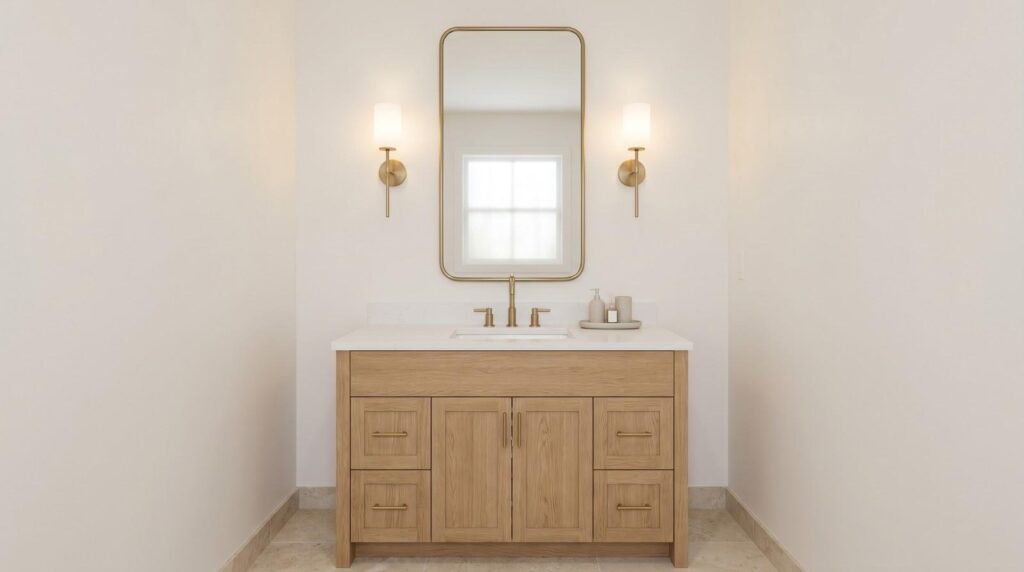
Shape sets the tone. A tall rectangle elongates sightlines, while a round mirror softens boxy architecture and works well with wall sconces. Mount the glass so its midpoint meets eye level for the shortest household member; nobody wants to crouch for mascara.
Lighting completes the setup. Flank the mirror with sconces or pick an LED-backlit model. The American Lighting Association notes that side fixtures at eye level provide even, shadow-free illumination, so you spend less time chasing stray hairs and more time out the door.
Need stealth storage? Replace a flat mirror with a recessed medicine cabinet. Today’s versions hide outlets for toothbrushes yet sit nearly flush, keeping that spa-like profile.
Mirror plus targeted lighting may be the most affordable space enhancer you can add. No demolition needed—just thoughtful placement and a few focused lumens.
10 Light and bright: blend the vanity into an airy palette
Bold color suits some tastes, but many small baths feel calmer with soft tones. Choose a vanity in warm white, pale grey, or bleached oak and let walls, tile, and cabinet merge into one quiet backdrop. The eye moves across the room without pausing, so boundaries appear farther apart than they are.
Color science backs the trick. Lighter surfaces reflect more light, bouncing daylight and fixtures around and reducing the shadows that make rooms feel tight. Pair the vanity with a matching quartz top, then echo the hue on wall paint or large-format tile. The cabinet fades and a 5 ft × 8 ft (1.5 m × 2.4 m) bath can read more like 6 ft × 9 ft (1.8 m × 2.7 m).
Texture prevents the look from turning clinical. A fluted or reeded front adds subtle vertical lines, while brushed-nickel hardware provides a low-key glint against the monochrome palette.
For a Scandinavian-inspired feel, try a white-washed oak console, matte-black faucet, and lightweight linen curtain. Prefer coastal? Opt for a driftwood-grey vanity with crisp white shiplap. Both schemes stay open, calm, and timeless even when square footage is fixed.
Conclusion
From floating forms to slim profiles and bold color pops, a 36-inch vanity offers countless ways to enhance a small bathroom. Combine the ideas that match your taste and layout to create a space that feels spacious, organized, and uniquely yours.
