

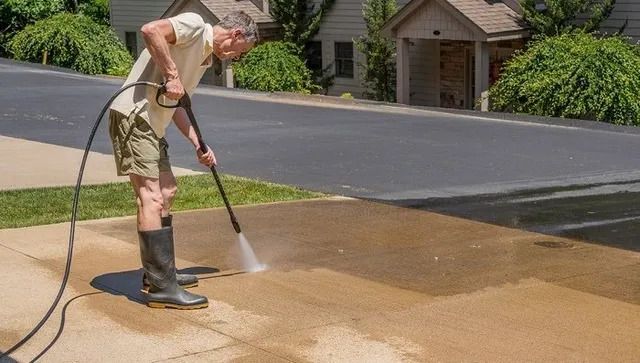
So here’s the thing about pressure washing that most people don’t get.
They think it’s just pointing a high-powered hose at something dirty and watching the grime disappear. And yeah, that’s part of it. But there’s a whole science behind what we do, and honestly, it’s gotten way more technical over the years.
I’ve been covering home maintenance and exterior cleaning for over a decade now, and the amount of innovation in this space? It’s kind of wild.
I remember when I first started writing about home services, pressure washing was treated like the simple cousin of home improvement.
Now we’re talking about PSI calculations, surface porosity assessments, biodegradable polymer chains in cleaning agents. The industry matured.
Today I want to break down what’s actually happening when professionals clean exterior surfaces. Not the basic stuff you see in weekend warrior tutorials.
The real technical considerations that separate a good cleaning from property damage or environmental harm.
8 Technical And Environment Dimensions Of Modern Pressure Washing
Modern pressure washing sits at this interesting intersection of physics, chemistry, and environmental science. You’ve got water pressure that can cut through concrete if mishandled.
Chemical reactions breaking molecular bonds in organic stains.
Equipment that needs to balance cleaning power against surface preservation.
And that’s before we even get into water reclamation, runoff regulations, or the ecological impact of what you’re washing off these surfaces.
Each dimension builds on the others.
Can’t talk about chemicals without understanding pressure. Can’t discuss sustainability without knowing what surfaces you’re treating and how.
The Science Behind Pressure Washing Technology
Pressure washing comes down to PSI and GPM. That’s pounds per square inch and gallons per minute.
PSI measures the force. GPM measures the volume.
You need both working together. I’ve seen people obsess over having the highest PSI machine they can find, thinking more pressure equals better cleaning. Not how it works.
A 4000 PSI unit with 2 GPM won’t clean as effectively as a 3000 PSI unit with 4 GPM in most residential applications.
The water volume does the rinsing and carrying away of debris.
There’s also the nozzle science.
The spray pattern changes everything.
A zero-degree nozzle concentrates all that force into a pencil-thin stream.
It’ll strip paint, etch concrete, destroy wood fibers.
A forty-degree nozzle spreads that same force across a wider area, gentler but still effective for most surfaces.
Then you’ve got hot water versus cold water systems. Hot water machines cost more, weigh more, require more maintenance. But they cut through oil and grease like nothing else. The heat accelerates the chemical reactions happening on the surface. It’s basic thermodynamics.
In professional workflows, including those followed by premier pressure washing specialists, technicians begin with a surface assessment to identify material type, wear level, and previous treatments.
This determines equipment settings before any water hits the surface.
Temperature control matters more than people realize.
Water heated to 200 degrees Fahrenheit will clean differently than water at 180 degrees.
The chemical performance changes. The safety considerations change. Everything shifts.
Surface-Specific Pressure Washing Techniques
Here’s where experience separates pros from weekend renters.
Concrete can handle higher pressure, but you still need to watch for spalling or existing cracks.
Too much pressure on deteriorated concrete just makes it worse.
I’ve documented projects where improper technique created pitting that required resurfacing to fix.
Wood is tricky. Softwoods like cedar or pine? You’re looking at 500-600 PSI maximum, often less.
The water pressure can actually raise the grain, create furring, or blow out the lignin that holds the wood fibers together.
I talked to a deck restoration specialist last year who showed me photos of redwood that looked like it had been attacked by termites.
It was just bad pressure washing technique.
Vinyl siding seems durable, but high pressure can drive water behind the siding, leading to mold growth in wall cavities.
You want to spray at a downward angle, never up. Never force water into the seams.
Brick and masonry need attention to the mortar joints.
Old mortar, especially lime-based mortar on historic buildings, can erode under pressure.
You might clean the brick beautifully and completely destroy the structural integrity of the wall.
Asphalt shingles on roofs require low pressure application, usually called soft washing.
You’re relying almost entirely on chemical action rather than pressure.
Too much force strips the protective granules off the shingles, shortening their lifespan by years.
Actually, most roof cleaning shouldn’t even be called pressure washing anymore.
It’s chemical application with a low-pressure rinse.
Cleaning Agents and Chemical Innovations
The chemistry has gotten more sophisticated.
Sodium hypochlorite still dominates for organic stain removal. That’s your mold, mildew, algae. It oxidizes organic material at the molecular level.
Concentration varies by application, anywhere from 1% to 3% in the final mix for most residential work.
But we’re seeing more targeted formulations now.
Enzyme-based cleaners that literally digest organic matter.
They work slower than oxidizers but they’re less harsh on vegetation and don’t require as much neutralization.
Surfactants have improved too.
These reduce surface tension, help chemicals cling to vertical surfaces, encapsulate dirt particles for easier rinsing.
Modern surfactants are less likely to streak or leave residue. Some are designed to biodegrade within hours of application.
There’s innovation in degreasers for oil-stained driveways.
The newer formulations use microbial action or nano-technology to break the bond between petroleum products and concrete. Sounds fancy, but it works.
One development I find interesting is color-coded chemical systems. Different colors indicate different pH levels or chemical functions, helping technicians avoid dangerous mixing or applying the wrong product to the wrong surface. Simple idea, but it prevents a lot of problems.
pH-neutral cleaners gained popularity for sensitive surfaces.
They clean through mechanical action and specialized surfactants rather than harsh acids or alkalis.
Environmental Impact of Pressure Washing
This is where the industry has had to grow up.
Every time you pressure wash something, you’re creating runoff.
That runoff contains whatever was on the surface—dirt, oils, heavy metals from brake dust, pesticides from lawn treatments, paint chips, chemical cleaners. All of it flows somewhere.
Most residential jobs send that runoff into storm drains, which typically don’t connect to water treatment facilities. Straight into local waterways.
I covered a story a few years back about a creek in a residential area that had elevated sodium hypochlorite levels traced back to roof cleaning operations.
The water volume matters too.
A typical house wash might use 300-400 gallons of water.
A large commercial property? Could be thousands of gallons. In drought-prone areas, that’s not insignificant.
Then there’s the chemical persistence question.
How long do these cleaning agents remain active in the environment? Sodium hypochlorite breaks down relatively quickly when exposed to sunlight and organic matter. Some degreasers? Not so much.
Heavy metals are another concern.
Older painted surfaces can contain lead or cadmium.
Pressure washing creates aerosolized particles that can be inhaled or contaminate soil.
Noise pollution doesn’t get discussed much, but gas-powered pressure washers are loud. In dense neighborhoods, that matters.
Sustainable Pressure Washing Practices
The industry’s response has been interesting to watch.
Water reclamation systems are becoming more common on commercial jobs.
These vacuum up the runoff, filter it, and either reuse it or dispose of it properly.
The systems aren’t cheap—you’re looking at several thousand dollars for a basic setup. But they prevent contaminated water from entering storm systems.
Some contractors are switching to biodegradable, phosphate-free cleaning agents.
They cost more per gallon but break down faster in the environment.
The performance gap between eco-friendly and traditional chemicals has narrowed significantly.
Pre-wetting and plant protection protocols have become standard practice.
Saturating vegetation before applying chemicals, covering sensitive plants, rinsing thoroughly afterward. It’s not perfect, but it helps.
There’s also a move toward lower water volume techniques.
Better nozzles, more efficient application methods, relying more on chemical dwell time rather than just blasting water at the problem.
Electric pressure washers eliminate the emissions and noise of gas engines.
They’re limited by cord length and available power, but for many residential applications, they work fine.
I’ve seen a few companies experiment with heated pure water systems that use no chemicals at all.
The equipment is expensive and it doesn’t work for every application, but the environmental impact is minimal.
Safety and Risk Management Considerations
This work is more dangerous than it looks.
The pressure itself can cause serious injury.
There are documented cases of injection injuries where the water stream penetrated skin and caused tissue damage requiring surgery.
A zero-degree nozzle at close range can cut you.
Ladder work adds fall risk.
Cleaning second-story surfaces, roofs, high walls—it requires proper ladder safety and sometimes scaffolding. Wet surfaces make everything more dangerous.
Chemical exposure is a constant concern.
Sodium hypochlorite irritates skin, eyes, and respiratory system.
Stronger degreasers can cause burns. Mixing incompatible chemicals can create toxic fumes.
I know of one incident where a contractor mixed an acid-based cleaner with a chlorine-based cleaner and ended up in the hospital from chlorine gas exposure.
Electrical hazards come up more than you’d think.
Water and electricity don’t mix.
Washing near electrical panels, outdoor outlets, or light fixtures requires careful planning.
There’s also the risk of electric shock from the machine itself if you’re using an electric model in wet conditions.
Property damage risk is huge.
Strip paint off a house, etch windows, kill landscaping, force water into places it shouldn’t go. Insurance claims from improper pressure washing are common.
Then there’s slip and fall liability. You’ve just made every surface wet and often slippery.
If a homeowner or their kid slips on the wet deck or driveway, that’s a problem.
Professional operators use personal protective equipment—eye protection, gloves, boots with good traction, sometimes respirators when working with strong chemicals.
They carry liability insurance, often with high coverage limits.
The Future of Pressure Washing Technology
The technology keeps improving.
Smart pressure washers with digital displays showing real-time PSI, flow rate, and temperature are becoming standard on professional equipment.
Some have preset programs for different surfaces or cleaning tasks.
There’s development in automation.
Robotic pressure washing systems for large flat surfaces like parking garages or industrial facilities.
They’re not replacing human operators yet, but for certain repetitive tasks, the technology is getting there.
Better chemical formulations keep coming.
More effective, faster-acting, less toxic, better for the environment. The research is ongoing.
Water filtration and recycling systems continue to improve and become more affordable.
What was only practical for huge commercial operations five years ago is now feasible for mid-sized contractors.
Battery technology advances might finally make cordless electric pressure washers viable for professional use.
Current battery-powered models are toys compared to gas or corded electric units, but that’s changing.
There’s also interest in plasma cleaning technology and dry ice blasting as alternatives to traditional pressure washing for certain applications.
Different physics entirely, but solving similar problems.
The regulatory environment is pushing innovation too.
More municipalities are implementing runoff regulations, chemical restrictions, noise ordinances. The industry has to adapt.
Conclusion
Pressure washing has come a long way from just spraying water at dirty surfaces.
The technical knowledge required to do this work properly and safely keeps growing.
Understanding hydraulics, chemistry, surface science, environmental regulations—it’s a lot more than it appears from the outside.
And look, the industry still has problems.
There are plenty of operators out there who don’t follow best practices, who damage property, who pollute waterways. But the direction is positive.
More professionalism, better training, improved equipment, greater environmental awareness.
If you’re hiring someone to pressure wash your property, ask about their techniques for your specific surfaces.
Ask about chemical selection and environmental protection. Ask about their insurance and safety protocols.
If you’re thinking about doing it yourself, understand that the learning curve is real. You can cause expensive damage quickly.
Not trying to scare you off, but respect the equipment and the process.
The technology will keep improving.
The methods will keep evolving. That’s what makes covering this industry interesting—there’s always something new developing just beneath the surface.
